Class No.09  Data Structures http://ecomputernotes.com
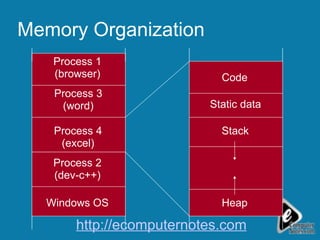
Memory Organization Code Static data Stack Heap Process 1 (browser) Process 3 (word) Process 4 (excel) Windows OS Process 2 (dev-c++) http://ecomputernotes.com
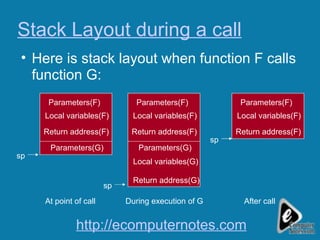
Stack Layout during a call Here is stack layout when function F calls function G: Parameters(F) Local variables(F) Return address(F) Parameters(G) Parameters(F) Local variables(F) Return address(F) Parameters(F) Local variables(F) Return address(F) Parameters(G) Local variables(G) Return address(G) During execution of G After call At point of call sp sp sp http://ecomputernotes.com
Queues A stack is LIFO (Last-In First Out) structure.  In contrast, a  queue  is a FIFO (First-In First-Out ) structure. A queue is a linear structure for which items can be only inserted at one end and removed at another end. http://ecomputernotes.com
Queue Operations Enqueue(X) – place X at the  rear  of the queue. Dequeue() -- remove the  front  element and return it. Front() -- return front element without removing it. IsEmpty() -- return TRUE if queue is empty, FALSE otherwise http://ecomputernotes.com
Implementing Queue Using linked List:  Recall Insert works in constant time for either end of a linked list. Remove works in constant time only. Seems best that head of the linked list be the front of the queue so that all removes will be from the front. Inserts will be at the end of the list. http://ecomputernotes.com
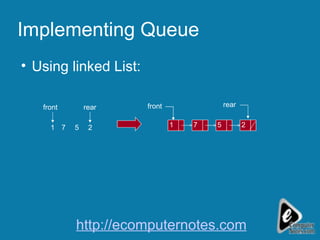
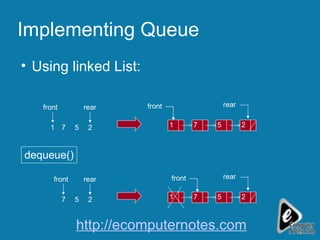
Implementing Queue Using linked List: front 2 5 7 1 1 7 5 2 front rear rear http://ecomputernotes.com
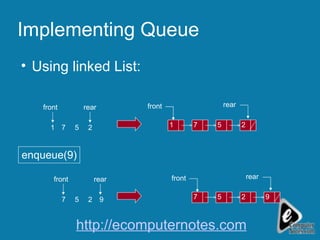
Implementing Queue Using linked List: front 2 5 7 1 1 7 5 2 front rear rear front 2 5 7 1 7 5 2 front rear rear dequeue() http://ecomputernotes.com
Implementing Queue Using linked List: front 2 5 7 1 1 7 5 2 front rear rear front 2 5 7 9 7 5 2 front rear rear enqueue(9) 9 http://ecomputernotes.com
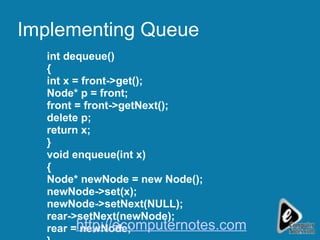
Implementing Queue int dequeue() { int x = front->get(); Node* p = front; front = front->getNext(); delete p; return x; } void enqueue(int x) { Node* newNode = new Node(); newNode->set(x); newNode->setNext(NULL); rear->setNext(newNode); rear = newNode; } http://ecomputernotes.com
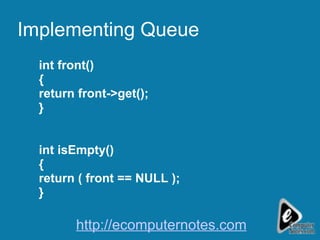
Implementing Queue int front() { return front->get(); } int isEmpty() { return ( front == NULL ); } http://ecomputernotes.com
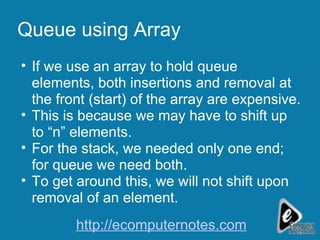
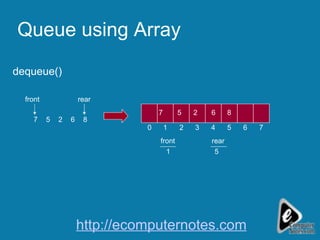
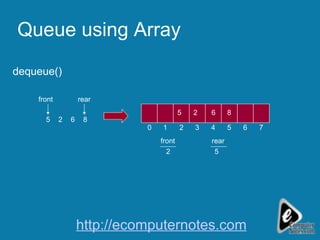
Queue using Array If we use an array to hold queue elements, both insertions and removal at the front (start) of the array are expensive. This is because we may have to shift up to “n” elements. For the stack, we needed only one end; for queue we need both. To get around this, we will not shift upon removal of an element. http://ecomputernotes.com
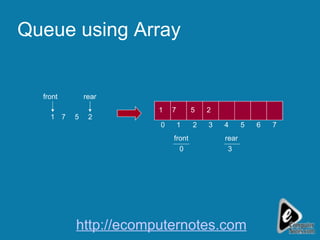
Queue using Array front 2 5 7 1 rear 6 5 7 0 0 1 3 2 4 front 1 7 5 2 3 rear http://ecomputernotes.com
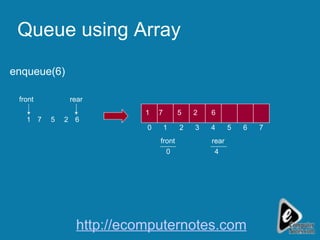
Queue using Array front 2 5 7 1 rear 6 5 7 0 0 1 3 2 4 front 1 7 5 2 4 rear enqueue(6) 6 6 http://ecomputernotes.com
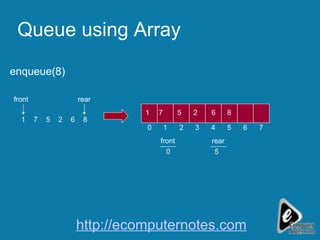
Queue using Array front 2 5 7 1 rear 6 5 7 0 0 1 3 2 4 front 1 7 5 2 5 rear enqueue(8) 6 6 8 8 http://ecomputernotes.com
Queue using Array front 2 5 7 rear 6 5 7 1 0 1 3 2 4 front 7 5 2 5 rear dequeue() 6 6 8 8 http://ecomputernotes.com
Queue using Array front 2 5 rear 6 5 7 2 0 1 3 2 4 front 5 2 5 rear dequeue() 6 6 8 8 http://ecomputernotes.com
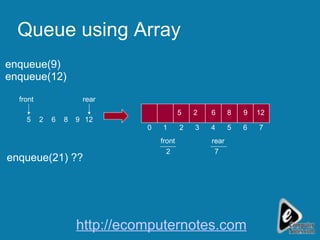
Queue using Array front 2 5 rear 6 5 7 2 0 1 3 2 4 front 5 2 7 rear enqueue(9) enqueue(12) 6 6 8 8 9 9 12 12 enqueue(21) ?? http://ecomputernotes.com
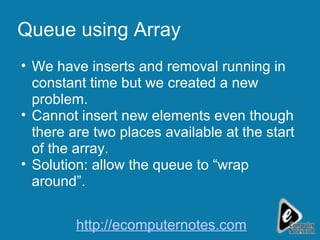
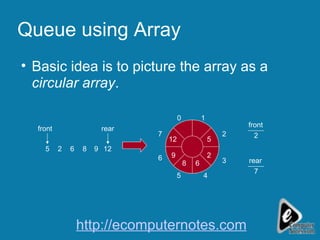
Queue using Array We have inserts and removal running in constant time but we created a new problem. Cannot insert new elements even though there are two places available at the start of the array. Solution: allow the queue to “wrap around”. http://ecomputernotes.com
Queue using Array Basic idea is to picture the array as a  circular array . front 2 5 rear 2 front 7 rear 6 8 9 12 6 5 7 0 1 3 2 4 5 2 6 8 9 12 http://ecomputernotes.com
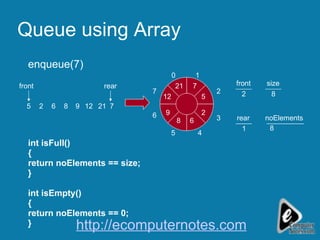
Queue using Array void enqueue(int x) { rear = (rear+1)%size; array[rear] = x; noElements = noElements+1; } front 2 5 rear 2 front 0 rear 6 8 9 12 6 5 7 0 1 3 2 4 5 2 6 8 9 12 enqueue(21) 21 21 8 size 7 noElements http://ecomputernotes.com
Queue using Array int isFull() { return noElements == size; } int isEmpty() { return noElements == 0; } front 2 5 rear 2 front 1 rear 6 8 9 12 6 5 7 0 1 3 2 4 5 2 6 8 9 12 enqueue(7) 21 21 8 size 8 noElements 7 7 http://ecomputernotes.com
Queue using Array int dequeue() { int x = array[front]; front = (front+1)%size; noElements = noElements-1; return x; } front rear 4 front 1 rear 6 8 9 12 6 5 7 0 1 3 2 4 6 8 9 12 dequeue() 21 21 8 size 6 noElements 7 7 http://ecomputernotes.com
Use of Queues Out of the numerous uses of the queues, one of the most useful is  simulation . A simulation program attempts to model a real-world phenomenon. Many popular video games are simulations, e.g., SimCity, FlightSimulator Each object and action in the simulation has a counterpart in real world. http://ecomputernotes.com
Uses of Queues If the simulation is accurate, the result of the program should mirror the results of the real-world event. Thus it is possible to understand what occurs in the real-world without actually observing its occurrence. Let us look at an example. Suppose there is a bank with four tellers. http://ecomputernotes.com
Simulation of a Bank A customer enters the bank at a specific time (t 1 ) desiring to conduct a transaction. Any one of the four tellers can attend to the customer. The transaction (withdraw, deposit) will take a certain period of time (t 2 ). If a teller is free, the teller can process the customer’s transaction immediately and the customer leaves the bank at t 1 +t 2 . http://ecomputernotes.com

computer notes - Data Structures - 9

  • 1.
    Class No.09 Data Structures http://ecomputernotes.com
  • 2.
    Memory Organization CodeStatic data Stack Heap Process 1 (browser) Process 3 (word) Process 4 (excel) Windows OS Process 2 (dev-c++) http://ecomputernotes.com
  • 3.
    Stack Layout duringa call Here is stack layout when function F calls function G: Parameters(F) Local variables(F) Return address(F) Parameters(G) Parameters(F) Local variables(F) Return address(F) Parameters(F) Local variables(F) Return address(F) Parameters(G) Local variables(G) Return address(G) During execution of G After call At point of call sp sp sp http://ecomputernotes.com
  • 4.
    Queues A stackis LIFO (Last-In First Out) structure. In contrast, a queue is a FIFO (First-In First-Out ) structure. A queue is a linear structure for which items can be only inserted at one end and removed at another end. http://ecomputernotes.com
  • 5.
    Queue Operations Enqueue(X)– place X at the rear of the queue. Dequeue() -- remove the front element and return it. Front() -- return front element without removing it. IsEmpty() -- return TRUE if queue is empty, FALSE otherwise http://ecomputernotes.com
  • 6.
    Implementing Queue Usinglinked List: Recall Insert works in constant time for either end of a linked list. Remove works in constant time only. Seems best that head of the linked list be the front of the queue so that all removes will be from the front. Inserts will be at the end of the list. http://ecomputernotes.com
  • 7.
    Implementing Queue Usinglinked List: front 2 5 7 1 1 7 5 2 front rear rear http://ecomputernotes.com
  • 8.
    Implementing Queue Usinglinked List: front 2 5 7 1 1 7 5 2 front rear rear front 2 5 7 1 7 5 2 front rear rear dequeue() http://ecomputernotes.com
  • 9.
    Implementing Queue Usinglinked List: front 2 5 7 1 1 7 5 2 front rear rear front 2 5 7 9 7 5 2 front rear rear enqueue(9) 9 http://ecomputernotes.com
  • 10.
    Implementing Queue intdequeue() { int x = front->get(); Node* p = front; front = front->getNext(); delete p; return x; } void enqueue(int x) { Node* newNode = new Node(); newNode->set(x); newNode->setNext(NULL); rear->setNext(newNode); rear = newNode; } http://ecomputernotes.com
  • 11.
    Implementing Queue intfront() { return front->get(); } int isEmpty() { return ( front == NULL ); } http://ecomputernotes.com
  • 12.
    Queue using ArrayIf we use an array to hold queue elements, both insertions and removal at the front (start) of the array are expensive. This is because we may have to shift up to “n” elements. For the stack, we needed only one end; for queue we need both. To get around this, we will not shift upon removal of an element. http://ecomputernotes.com
  • 13.
    Queue using Arrayfront 2 5 7 1 rear 6 5 7 0 0 1 3 2 4 front 1 7 5 2 3 rear http://ecomputernotes.com
  • 14.
    Queue using Arrayfront 2 5 7 1 rear 6 5 7 0 0 1 3 2 4 front 1 7 5 2 4 rear enqueue(6) 6 6 http://ecomputernotes.com
  • 15.
    Queue using Arrayfront 2 5 7 1 rear 6 5 7 0 0 1 3 2 4 front 1 7 5 2 5 rear enqueue(8) 6 6 8 8 http://ecomputernotes.com
  • 16.
    Queue using Arrayfront 2 5 7 rear 6 5 7 1 0 1 3 2 4 front 7 5 2 5 rear dequeue() 6 6 8 8 http://ecomputernotes.com
  • 17.
    Queue using Arrayfront 2 5 rear 6 5 7 2 0 1 3 2 4 front 5 2 5 rear dequeue() 6 6 8 8 http://ecomputernotes.com
  • 18.
    Queue using Arrayfront 2 5 rear 6 5 7 2 0 1 3 2 4 front 5 2 7 rear enqueue(9) enqueue(12) 6 6 8 8 9 9 12 12 enqueue(21) ?? http://ecomputernotes.com
  • 19.
    Queue using ArrayWe have inserts and removal running in constant time but we created a new problem. Cannot insert new elements even though there are two places available at the start of the array. Solution: allow the queue to “wrap around”. http://ecomputernotes.com
  • 20.
    Queue using ArrayBasic idea is to picture the array as a circular array . front 2 5 rear 2 front 7 rear 6 8 9 12 6 5 7 0 1 3 2 4 5 2 6 8 9 12 http://ecomputernotes.com
  • 21.
    Queue using Arrayvoid enqueue(int x) { rear = (rear+1)%size; array[rear] = x; noElements = noElements+1; } front 2 5 rear 2 front 0 rear 6 8 9 12 6 5 7 0 1 3 2 4 5 2 6 8 9 12 enqueue(21) 21 21 8 size 7 noElements http://ecomputernotes.com
  • 22.
    Queue using Arrayint isFull() { return noElements == size; } int isEmpty() { return noElements == 0; } front 2 5 rear 2 front 1 rear 6 8 9 12 6 5 7 0 1 3 2 4 5 2 6 8 9 12 enqueue(7) 21 21 8 size 8 noElements 7 7 http://ecomputernotes.com
  • 23.
    Queue using Arrayint dequeue() { int x = array[front]; front = (front+1)%size; noElements = noElements-1; return x; } front rear 4 front 1 rear 6 8 9 12 6 5 7 0 1 3 2 4 6 8 9 12 dequeue() 21 21 8 size 6 noElements 7 7 http://ecomputernotes.com
  • 24.
    Use of QueuesOut of the numerous uses of the queues, one of the most useful is simulation . A simulation program attempts to model a real-world phenomenon. Many popular video games are simulations, e.g., SimCity, FlightSimulator Each object and action in the simulation has a counterpart in real world. http://ecomputernotes.com
  • 25.
    Uses of QueuesIf the simulation is accurate, the result of the program should mirror the results of the real-world event. Thus it is possible to understand what occurs in the real-world without actually observing its occurrence. Let us look at an example. Suppose there is a bank with four tellers. http://ecomputernotes.com
  • 26.
    Simulation of aBank A customer enters the bank at a specific time (t 1 ) desiring to conduct a transaction. Any one of the four tellers can attend to the customer. The transaction (withdraw, deposit) will take a certain period of time (t 2 ). If a teller is free, the teller can process the customer’s transaction immediately and the customer leaves the bank at t 1 +t 2 . http://ecomputernotes.com

Editor's Notes